Changes to Superman's Costume throughout the Years
In the DC Comics, TV and Movies.
The Birth of an Icon: How Superman's Original Costume Became Legendary
When Superman first exploded onto the scene in 1938's Action Comics #1, he wasn't just a new breed of superhero; he was a pioneer of a whole new visual language for heroic icons. Superman's distinctive red, blue, and yellow costume design was boldly outstanding on the newsstands of the day, demanding attention and searing itself into the minds of readers. More than 80 years later, it remains one of the most recognizable and influential superhero costumes ever created.
The men responsible for Superman's classic look were writer Jerry Siegel and artist Joe Shuster. As struggling youths in the 1930s, they spent years developing the character that would eventually become the Man of Steel. Early incarnations of the character didn't feature a costume. Superman evolved into his now‑famous look only later in their collaboration. Their initial designs for his appearance went through several iterations before the 1938 fateful Action Comics #1 issue.

Siegel Shuster Early Illustration of Superman with color
Shuster’s design drew from the aesthetic of circus strongmen, wrestlers, and pulp heroes—the tight suit, trunks, red boots, and flowing cape evoked physicality and drama. The red trunks over blue bodysuit look evoked the old circus strongman of the 1930s aesthetic, inherently suggesting power and might. Although today it’s hard to imagine, traveling circuses and fairs once held a prominence in the public imagination. They presented the otherworldly, even the freakish imaginings of the abnormal. Superheroes came from such realms. The addition of a billowing cape created a larger-than-life, almost mythic quality befitting a modern demigod.
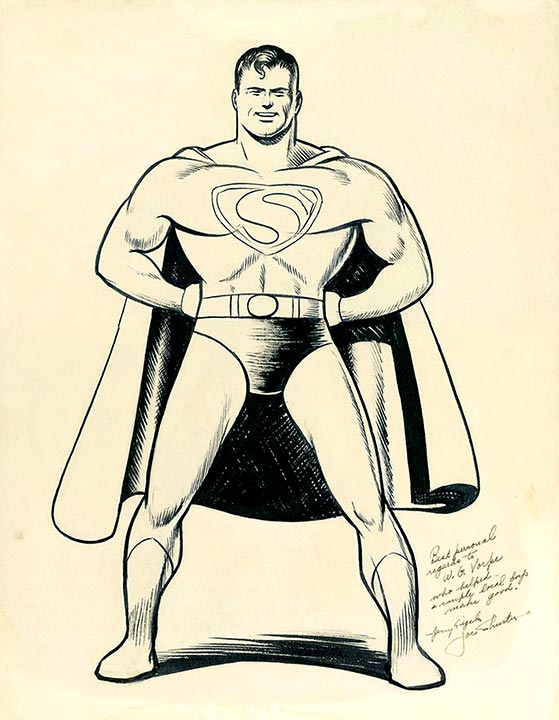
Illustrator: Siegel Shuster Early Illustration of Superman
But the true stroke of genius was the distinctive "S" emblem blazoned across Superman's chest. Using a uniquely stylized symbol rather than mere initials or letters was an inspired choice. It created an stunningly simple yet powerful identity that immediately captivated readers. Was it meant to be the letter S? A symbol for "Superman"? Its meaning was deliciously ambiguous, allowing the icon to take on deeper significance. The chest emblem, a stylized “S,” initially stood for “Superman.” Later, it became associated with the House of El and reinterpreted as the Kryptonian symbol for hope.
The color scheme brilliantly combined primary hues in an arresting way. While blue and red were common enough in comics of the time, Shuster's addition of the striking yellow background for the "S" shield made it sizzle off the page. It was the perfect accent to the patriotic red and blue color scheme, suggesting heroism, action, and warmth.
From a design theory perspective, Superman's classic suit is remarkably balanced and thoughtfully composed. The predominant blue bodysuit grounds the look, with the yellow emblem providing the eye-catching focal point. The red accents of the cape, boots and trunks add just the right splashes of color around this iconic center. In addition, these colors were chosen for the covers of early comics so they would catch readers' eyes on newsstands. Superman’s blue, red, and gold color palette has stood the test of time.

Superman 1940s comic illustration by Fred Guardineer
Legendary DC Comics artists like Joe Shuster, Fred Guardineer, and Wayne Boring would spend years refining the look. They carefully engineered the drape, textures, and body-hugging sculptural shapes to make the suit seem more tangible and wearable, more powerful in its representation of this alien physique.

Superman comic illustration by Wayne Boring
Over the years, the rendering of Superman’s suit has evolved. Compared to the early years his cape has become more windswept, with carefully rendered folds and ripples for more dynamic movement. The trunks and musculature have been subtly modernized. Even the cut and designs of the boots and belts have been consistently updated over time to keep Superman's costume feeling contemporary and striking despite its vintage origins.
Beyond just the visual craft behind Superman's original comic book look, the costume perfectly complemented the character's narrative and thematic underpinnings, too. The bright, primary colors suggested vibrancy, energy, and life - fitting for an alien immigrant reinventing himself as a protector of truth. The bodysuit's skin-tight fit and the cape's empowering silhouette imbued Superman with a mythic aura of power usually only afforded to gods and heroes from ancient legends.
In the end, Superman's iconic costume has endured and inspired countless reinterpretations and redesigns over the 80+ years since its debut precisely because its core concept is so simple, yet brilliant.
Superman the iconic S symbol
While every aspect of Superman's classic suit is meaningful at the heart of Superman’s costume lies the iconic “ S ” emblem, a powerful symbol recognized worldwide. Initially, it simply stood for Superman, serving as an initial and a clear identifier of the character
However, over time the meaning of the emblem was enriched. Notably, in Superman: Birthright (2004), the “S” was established as a Kryptonian symbol meaning “hope”, and as a crest of the House of El. This interpretation was further reinforced in the 2013 film Man of Steel, where Jor‑El explains the symbol means hope and is not actually the letter “S” which is essentially what Superman stands for, a symbol of hope that has been embraced around the world.
The emblem's memorable design originated from one of Joe Shuster's early concept sketches for a character he called "The Superman." Joe Shuster designed the original logo for Action Comics #1 (June 1938), rendering it as a stylized “S” inside a shield-like form, reminiscent of police badges or heraldic crests.
In these primordial drawings, the musclebound hero wore a body-tight union suit with a distinctive logo combining stylized underlines, serifs, and spurs to create an iconic insignia. When DC's publisher suggested changing the name to simply "Superman" to streamline it, the emblem stuck.
The “S” emblem has undergone subtle refinements in its line weights, curve proportions, and coloring. Its shape evolved from triangles to diamonds to refined pentagons, while its proportions and line weights have been tweaked to enhance visual impact. Yet these meaningful visual changes over decades continue to maintain its iconic graphic strength.
The emotional resonance of the colors has deepened over time: richer yellows and bolder reds have been adopted for better contrast and visibility. The central spurs were sharpened into points, making the overall shape more dynamic, angular, and purposeful. Such small adjustments solidified the symbol's ability to demand attention on a comic book cover or printed page.
The enduring power of the “S” shield lies in its balance of simplicity and distinctiveness. Its clean geometry, fluid curves, italicized slant, and heraldic underpinnings allow it to stand out without decoration, making it instantly recognizable and adaptable across varying scales and media, from comic panels to cinematic costumes.
Its versatility also enables dramatic reinterpretations: depictions of battle-worn, eroded crests in comic scenes, stylized sunbursts revealing the “S,” or textured, three-dimensional forms in films, all underline the emblem’s narrative and visual flexibility.
Some postulate that it perfectly complemented the character's role as an embodiment of steadfast heroism elevated to iconic levels of storytelling. Superman's deeds and ethics were meant to be plain and self-evident to represent truth, justice, and moral straightforwardness. Yet the way he manifested those ideals was extraordinary, unique, and instantly recognizable - just like his symbolic chest emblem.
Another brilliant aspect of the emblem's design was its incredible versatility and endless ability for reinterpretation. Those simple core graphics could be replicated at any scale, from a miniature symbol on a comic book figure to an emblem spanning an entire chest plate in a live-action movie costume. There are a number of Superman t-shirt designs that are apt examples of its design versatility potential.

DC Comics 1960 version of the Superman Symbol
On the comic book page as well as in the movies, artists and designers have experimented with giving the logo dimensions and dynamism. It could be rendered as a carved, eroded symbol on Superman's chest, battered from battles. Or the yellow background might blast away in sunburst patterns, with the iconic "S" periodically obscured by cape sweeps or debris to add drama to each panel. No other superhero symbol possessed that instantly identifiable flexibility. The emblem also allowed for intriguing symbolic reinterpretations and mashups over the decades. It was a pliable yet profoundly meaningful centerpiece for boundless creative explorations of the character.
See the numerous iterations over the years of the Superman Logo.
From its debut in the late 1930s through the Golden, Silver, and Bronze Ages of comics, Superman’s costume, anchored by that singular emblem, has required only cosmetic tweaks to remain relevant. That consistency speaks to the emblem’s primal visual appeal and symbolic power
Regardless of future reboots or reimaginings, the “S” shield will remain integral to Superman’s identity, as a mark of hope and as one of the most enduring symbols in popular culture.
The Muscular Marvel TV Years

1952 Superman TV series George Reeves
When Superman hit the small screen in Adventures of Superman starring George Reeves from 1952-1958, the costume design translated remarkably faithfully. With the limitations of a live-action TV budget, the suit had slightly looser musculature and the cape had less dramatic movement, but the core elements were all there. Reeves even sported the underwear-like trunks on the outside. The iconic red, blue and yellow uniform was made by costume designer Izzy Berne, who worked for Lippert Studio. The studio was a subsidiary of National Publishing that eventually became DC Comics. Made of jersey wool, a somewhat stretchy fabric, but far from the elastic fibers of modern garments, the suit was heavy. George Reeve’s Superman costume is preserved at Smithsonian Institution.

Justice League Of America 63 DC 1968 Cover Batman
1960-1970's
By the late 1960s, American society was undergoing major cultural transformations—civil rights activism, the Vietnam War, and a broader generational questioning of tradition were reshaping popular media. While Superman’s comic adventures at DC were still rooted in the classic heroism of earlier decades, the overall comics industry was beginning to feel the influence of a younger wave of creators. Artists like Neal Adams brought a more naturalistic, dynamic visual style to superhero books, while contemporaries at Marvel such as Jim Steranko experimented with psychedelic layouts and bold graphic design. Though Superman’s own titles remained comparatively conservative in tone, DC’s editorial leadership, including figures like Julius Schwartz, showed an increasing willingness to modernize aspects of their flagship hero to keep pace with changing tastes, particularly in updating supporting cast fashions, story pacing, and page composition.
On television, Superman remained firmly associated with the wholesome image established in Adventures of Superman (1952–1958), with George Reeves’ brightly colored costume and straightforward, optimistic portrayal still defining the character for many viewers. That image persisted in animation throughout the 1960s and 1970s, notably in Filmation’s The New Adventures of Superman and Hanna-Barbera’s Super Friends, both of which retained the traditional red trunks and classic emblem. In film, it wasn’t until 1978’s Superman: The Movie, with Christopher Reeve in the lead, that the character received a major cinematic reinterpretation. Costume designer Yvonne Blake kept the trunks but refined the materials, colors, and fit to give Superman a more streamlined, photogenic appearance suitable for the big screen. These adaptations demonstrated that while the comics were cautiously evolving, the core costume design remained intact across all media, still rooted in the same fundamental visual language that had defined Superman since 1938.
Side-by-Side: Superman’s Classic vs. Trunk-less Era for MainLine Continuity
|
Feature |
Classic Costume (1938–2011) | Trunk-less Costume (2011–2018) |
|---|---|---|
| Chest Emblem | Large “S” shield on a bright yellow background, often with bold red border and stylized curves. | Similar “S” shield, but more angular and modernized by Jim Lee, with subtle metallic shading. |
| Trunks | Bright red trunks worn over blue bodysuit, separating the torso from the legs visually. | No trunks — blue bodysuit extends from shoulders to boots, with red detailing shifted to belt area. |
| Belt | Simple yellow belt with oval or rectangular buckle. | Red or gold armored belt integrated into suit’s design, often angular and segmented. |
| Boots | Red, typically plain or with a small yellow trim in some versions. | Red boots, often featuring stylized paneling and armor-like lines. |
| Material Look | Smooth fabric appearance, reflecting circus strongman origins. | Armored, textured panels suggesting alien Kryptonian technology. |
| Tone & Style | Bright, optimistic, timeless superhero look. | Sleek, modern, cinematic style influenced by film and digital comics trends. |
| Debut | Action Comics #1 (1938) | Justice League #1 (New 52, 2011) |
| Notable Return | Worn continuously until August 2011. Returned April 2018 in Action Comics #1000. | Lasted from September 2011 until early 2018 in mainline continuity. |

John Byrne 1986 Man of Steel
John Byrne considered and briefly depicted a trunk-less Superman in the mid-1980s but only in certain promotional and Elseworld-style artwork, not in the actual post-Crisis main timeline.
John Byrne’s 1986 Man of Steel miniseries, which relaunched Superman in the post-Crisis on Infinite Earths continuity, introduced a more streamlined, modernized take on the character’s costume, but contrary to some reports, the red trunks were not removed in the canonical monthly comics. Byrne adjusted proportions, refined the “S” shield, and altered the belt design to make the outfit sleeker, but the trunks remained a defining part of the look. While some of Byrne’s concept art and non-continuity promotional imagery experimented with a fully trunk-less bodysuit, this was never adopted in the mainline stories of the time. The character’s updated physique and cleaner lines still marked a significant break from the bulkier, more ornate Silver Age style, but visually, the classic trunks persisted throughout Byrne’s run.
The actual in-continuity removal of Superman’s trunks didn’t occur until 2011, when DC Comics launched its New 52 initiative. Designed by Jim Lee, this suit featured Kryptonian armor-style paneling, a high collar, and no trunks, marking the first time in the character’s 73-year publishing history that the mainline Superman wore a trunk-less outfit in regular comics. The redesign was controversial among fans, with some praising the fresh, modern aesthetic and others lamenting the loss of a classic element tied to Superman’s Golden Age origins. While Byrne’s 1986 run modernized Superman’s look and briefly flirted with trunk-less imagery in supplemental material, it was The New 52 that made the change canonical in ongoing continuity.
2011 Costume Overhaul: When Superman Went Trunk-less in the Mainline Continuity Timeline
For more than seven decades, Superman’s red trunks over his blue bodysuit were as instantly recognizable to fans as his super strength and unwavering morals. The classic costume, first seen in Action Comics #1 (1938), became a visual shorthand for truth, justice, and the American way.
That changed in 2011, when DC Comics launched its New 52 initiative—a company-wide reboot designed to modernize characters for a new generation of readers. As part of this redesign, artist Jim Lee introduced a streamlined, armored look for Superman that eliminated the red trunks entirely. The decision, while controversial, was aimed at giving the Man of Steel a sleeker, more contemporary appearance in line with the cinematic trend toward realistic superhero suits. For many fans, it was the most radical change to Superman’s visual identity since his creation.
The absence of the trunks lasted for several years, including in the Man of Steel (2013) film and subsequent big-screen appearances. Then, in 2018, DC brought back the classic red trunks in celebration of Superman’s 80th anniversary with Action Comics #1000. The return was framed not as a step backward, but as a tribute to the character’s enduring legacy—proving that some symbols, no matter how old-fashioned they might seem, still hold a powerful place in the hearts of readers around the world.
The Christopher Reeve Era
When Superman hit the big screen in 1978's Superman: The Movie, the costume had to be truly functional for stunts and wirework. Designer Yvonne Blake crafted a very faithful adaptation of the comics look, with the sculpted muscles, trunks, and cape all getting an amazing real-world interpretation. Christopher Reeve's suit would inspire many future live-action takes.

Christopher Reeve’s in the 1978 film, Superman.
Lois & Clark's Bright Tights
In the 1990s TV series Lois & Clark: The New Adventures of Superman, Dean Cain's Super suit stuck very closely to the comics look - bright blue bodysuit, red trunks, and a classically draped cape. It may have looked a bit too reminiscent of bright tights and underwear, but it pleased classic fans.

TV series Lois & Clark: The New Adventures of Superman (Dean Cain)
The series aired on ABC from September 12, 1993, to June 14, 1997.
In the previous live-action Superman movies starring Christopher Reeve (Superman: The Movie in 1978, Superman II in 1980, Superman III in 1983, and Superman IV: The Quest for Peace in 1987), Superman wore a costume that was very faithful to the classic comic book look, including the red trunks over blue bodysuit.
Even when director Bryan Singer rebooted/continued the Superman film franchise with Superman Returns in 2006, starring Brandon Routh as Superman, the costume was updated without much of a notable change.

Brandon Routh as Superman in the 2006 film, Superman Returns
Routh's Superman costume featured a seamless, cuff less blue muscle suit/bodysuit with the iconic 'S' emblem on the chest and gold belt, with an almost burgundy red cape, trunks and boots red shorts/trunks over the suit. Did this gave the costume a more modern, streamlined aesthetic compared to previous movie versions. That’s up for debate. Unfortunately, the film bombed and Warner Bros. cancelled the sequel deciding instead reboot the Superman character for another movie, Zack Snyder’s “Man of Steel.”
In the Movies: The No Trunks Rebirth, Finally.
The Superman movies began removing the underwear-looking trunks from Superman's suit starting with Zack Snyder’s Man of Steel, 2013 movie. Man of Steel features a redesigned Superman costume by James Acheson and Michael Wilkinson. The costume preserved the color scheme and "S" logo, but adopted darker tones. Most notably Superman’s suit no longer features the red trunk. According to Wikipedia Zack Snyder and the producers attempted to devise a suit featuring the red trunks, but could not design one that fit into the tone of the film, leading to their removal from the suit. After the fact, Zack Snyder said the costume was a modern aesthetic take on the familiar suit.

2013 Man of Steel Film - Henry Cavill as Superman
The choice to ditch the trunks was carried over into subsequent Superman appearances in the DC Extended Universe movies as well. In Batman v Superman: Dawn of Justice (2016), and other DCEU films, Henry Cavill's Superman also wore a trunk-less suit.
So while the trunks were an integral part of Superman's classic comic book costume for decades, the 2006 film Superman Returns kicked off the trend in live-action movies of removing them for a smoother, more updated look on the big screen. This trunk-less design has remained for Superman's cinematic appearances since then.
Starting with Superman Returns in 2006, live-action movies began removing the underwear-looking trunks from the suit. Brandon Routh's costume had a sleek blue muscle suit with the iconic emblem but no exterior red shorts. This trunkless look was carried through into Man of Steel, Batman v Superman, and subsequent DCEU movies with Henry Cavill. It polarized some die-hard fans but gave the costume a more modern, stripped-down aesthetic.
The newest iteration of Superman's costume design in the movies is the version seen in Zack Snyder's Justice League, released in 2021.
In this recut and expanded version of the 2017 film Justice League, Henry Cavill's Superman suit received some noticeable updates and refinements compared to his previous DCEU appearances in Man of Steel and Batman v Superman: Dawn of Justice.
- The key changes to the suit design in Zack Snyder's Justice League include:
- Brighter, More Vibrant Colors The blue bodysuit has a richer, more vibrant tone compared to the slightly muted, desaturated shades in the previous films. The reds of the cape and boot colors are also punchier and deeper.
- Updated Cape Design Superman's cape received some modernization, with a sleeker armor-like pattern woven into the top shoulders/back area. The cape itself appears slightly shorter as well.
- Alien Muscle Texturing More defined alien muscle textures are sculpted into the suit, giving it an extraterrestrial, almost biomechanical look compared to a simple spandex suit.
- Tweaked Emblem The iconic 'S' emblem on the chest has been subtly refined, with a more angular geometric shape and darker outline to make it pop more prominently.
Overall, while keeping the core trunk-less bodysuit approach used since Superman Returns in 2006, this version of the suit in Zack Snyder's Justice League aims for a more striking, alien-influenced aesthetic befitting Superman's Kryptonian heritage.
The updates lean further into making the suit feel like an organic extension of Superman's body rather than just apparel. The bolder colors and emblems also help the costume really pop amid the film's heavily color-graded, high-contrast visual style.
Unless the planned future of the DCEU radically changes directions, this sleeker, more textured, and technicolor approach is likely to be the foundation for any new live-action Superman suits moving forward on the big screen. It's an evolution aimed at keeping the character's iconography feeling modern and distinctly powerful.
The Comic Book Reboot / Red Trunk Removal
The New 52 was the 2011 revamp and relaunch by DC Comics of its entire line of ongoing monthly superhero comic books. Following the conclusion of the "Flashpoint" crossover storyline, DC cancelled all its existing titles and debuted 52 new series in September 2011.
It was during this 2011 revamp that DC Comics, itself, finally got rid of Superman's trunks with the New 52 universe. Artists like Jim Lee redesigned the Man of Steel’s outfit as a sleek, trunkless bodysuit with the iconic emblem, subtle muscle texturing, a display of kryptonian tech, and a more regal-looking cape. This look has persisted in the comics for a number of years, now, though alternate storylines occasionally will bring back the briefs.

DC Comics Jim Lee Illustration of Superman for the Reboot
Individual artists introduced new iterations on Superman’s costume. Jim Lee, in Justice League #1 had the Man of Steel sporting an elaborate outfit – sans trunks- with an armor looking suit, a Mao type collar on the under tunic and gauntlet-like wrist detailing. This look didn’t catch on. Nor did the Action Comics#1 cover that revealed Superman wearing a t shirt and jeans! If you're looking for Classic Superman, jeans and a t shirt is a look that's not going to have a lot of appeal. It might be enough of a turn off for some folks that they would not even open the comic’s cover let alone even get to page one.

DC Comics Superman Action Comics: The New 52 Cover #1
The newest major iteration of Superman's costume design in the comics came with the 2016 "Rebirth" relaunch by DC Comics. After the controversial New 52 reboot in 2011 ditched Superman's iconic red trunks for a more armored, trunks-less suit, the 2016 Rebirth aimed to restore some classic elements while keeping a contemporary look.
However, you need to keep in mind that Superman also appears in a number of different DC Comics including Action Comics and Justice League. In Zack Snyder's Justice League, Superman returns wearing his iconic costume in black! Writers brought back Superman’s black suit in Action Comics #729 during a period where he temporarily lost his ability to draw on the sun’s energy.

1993 Action Comics #689 Superman wearing a black jumpsuit.

2021 Zack Synder Justice League Superman - Henry Cavill
Read Darkening Skies: Explaining Superman's Black Suit if you want to understand this departure from Superman’s traditional red and blue outfit. The Superman has worn black costumes in other media as well:
- Superman wore a modified black costume when he appeared in Batman Beyond.
- Clark Kent donned a black costume with a dark trench coat in the ninth season of Tom Welling’s Smallville when Clark was trying to cut himself off from humanity and embrace his Kryptonian heritage.
- During the Arrowverse’s Else worlds crossover, Tyler Hoechlin as Superman wore a black costume.
Now, there's nothing that upsets a Superman fan more than the feeling of their favorite hero becoming unrecognizable, and as a result, the New 52 Superman's days were numbered.
Did You Know….
Superman can wrap a person or item in his cape, protecting from friction, cold, heat and rigors of the space, with enough air to travel interplanetary distances. The cape will block even radio frequencies. The Super Uniform is very stretchable. It will lose its properties while under a red sun.
The Classic Superman Suit Mostly Returns in Rebirth in 2017
An understated red Belt/Emblem belt offers a subtle reference to the original red trunks
- A blue bodysuit, though rendered in a sleeker style
- Updated Kryptonian Muscle Texture The suit had a more organic alien muscle texture giving it a bioengineered feel, similar to the armored New 52 suit but not as pronounced.
- Tweaked Color Shades The reds were richer with an almost metallic qualities, while the blues took on a predominant navy hue.
- Silver gauntlet cuffs
- Boots appear either dark blue- like main suit- boot color with thin red detail
This melded approach by artists like Patrick Gleason and Doug Mahnke attempted to split the difference between the classic and sleeker modern looks. The familiar trunks returned, but as the same color as the rest of the suit so they don’t stand out. The all over look with its various alien textures and tech accents nod to Superman's powerful origins.
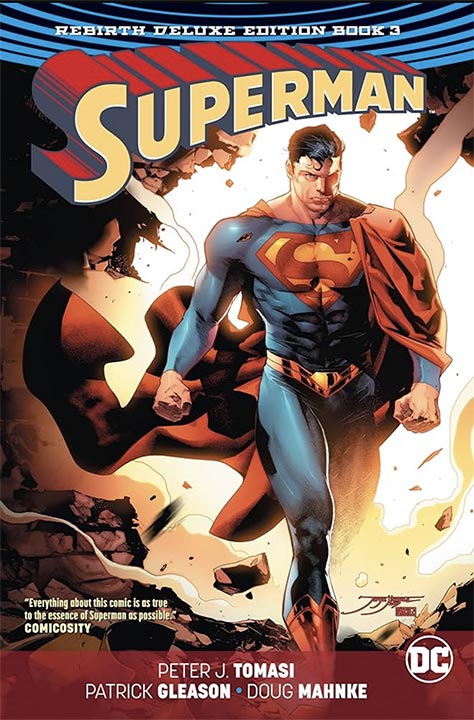
Since Rebirth, Superman's main costume has remained relatively consistent, though artists continue playing with slight material texture and color variances. The core concept persists of balancing classic underwear-on-the-outside elements with contemporary armor and tech stylings.
While not as drastically overhauled as the New 52 look, Rebirth's Superman suit aims to pay respect to 80 years of iconography while keeping the character's image feeling modern and a bit reinvented for new generations to come. It's a fittingly reverent yet bold new approach for the Man of Tomorrow's endless costume evolution.
Read this 2017 press announcement from DC Comics.
DC Comics Announces An Update for Superman’s Costume Design Post-Superman Reborn
by Antonio Jose Chavez January 13, 2017 0 comment
Yet as the Rebirth series drew to an end, new changes in Superman’s outfit appeared. The main artist Patrick Gleason is moving towards the red, yellow and blue color scheme of old with Superman’s boots now returning to a red and his belt becomes more visible in a sort of metallic red, a gold S insignia is seen on the buckle, and there are no cuffs.
2023 Red Trunks Are In??
According to DC Studios co-CEO James Gunn who celebrated Superman Day on June 12 2023 by posting an image on Twitter of various Superman costumes the character has worn over 85 years. During this February, 2023 post, Gunn polled his X followers on whether Superman should wear trunks, and 59.3% voted that he should.

2024 Promo shot for 2025 release of Superman: Legacy film
Will the “Superman: Legacy” Superman Costume Have Red Trunks?
There appear to be a many disparate influences at work with the new Superman costume that was just revealed in May 2024 for the upcoming 2025 Corenswet’s Superman movie. Although it is not a complete detour from recent live-action Superman costumes, there certain elements do draw upon the classic Superman comics, including the return to the red trunks.
Read these articles to learn more:
Will the “Superman: Legacy” Superman Costume Have Red Trunks?
2024: A Full Circle in the Movies with the new 2025 Gunn’s Superman Movie
Christopher Reeve and Brandon Routh as Superman wore trunks before Henry Cavill and Zack Snyder jettisoned them for their 2013 movie, Man of Steel. Well, they are back, and purists will be delighted. The new costume isn’t designed to appear skin-tight like the spandex-type suit worn in most of the hero’s previous live-action iterations, including the padded and sprayed musculature of Henry Cavill’s recent incarnation as well as in movies such as Man of Steel, Batman v Superman, Zack Snyder’s Justice League, and Black Adam. Other design elements beside the addition of the trunks that have been tweaked to include a mock neck to the costume and textural elements on the sleeves and pants. Yet, overall, the costume remains in its traditional blue with red trunks, red cape, red boots, yellow belt, and, of course, the iconic red and yellow “S” on the chest. Some articles suggest that it is a mix between an athlete’s uniform for contact sports, and a worker’s protective uniform for a dangerous labor-intensive job. We feel that it looks sturdy and protective, yet form-fitting and streamlined. When the promotion for the movie starts, we’ll have a better idea of Superman’s newest costume iteration for the movies.

Read this 2024 GQ’s article for more information:
Superman Costume Revealed: We Have a Suit, and the Suit Has Trunks
By William Goodman May 6, 2024
While certain elements like the cape, "S" emblem, and general color scheme have remained, Superman's costume continues to be reinterpreted and modernized by each new creative team in comics, movies, and TV. Nevertheless, it remains one of the most instantly recognizable superhero looks in the world.

